
Between the Mountain and the Meal

Ritual, identity, and what gets borrowed along the way
Ask a Mahali elder in Edelbera village what holds the community together, and he will not talk about politics or policy. He will talk about food, about mountains, about the first mango of the season. He will talk about a goddess who must be fed before anyone else eats. And he will tell you that when someone in the village marries an outsider, the whole village must be fed too.
These are not separate stories. They are three threads of the same one.
The Mahali are a Scheduled Tribe community living across Jharkhand, Odisha, and West Bengal. According to Tapeshwar Mahali, their name comes from mad, the Santali word for bamboo. For generations, bamboo has been at the heart of their livelihoods. But their culture tells a story that goes much further than bamboo.
Not all of their rituals were born within the community. Some were adopted from neighbouring communities. Others came through long years of living together on shared land. Over time, the Mahali took these practices in and made them their own.
Three of these rituals, in particular, show how a community holds itself together across time. One comes from the mountain. One came from outside. And one is about what happens when the boundaries of the community begin to shift.
The Mountain's Call: Marang Buru Bonga
Every April, before the sun is fully up, the men of Edelbera walk into the forest. They carry mahua flowers, kumkum, ripe mangoes, sweetmeats, a sacrificial sheep, and the weight of everything that went wrong in the year behind them. They are going to meet Marang Buru, the mountain spirit, and Goddess Paudi, whose temple waits at the summit.
The Marang Buru Bonga is the oldest and most rooted of Mahali spiritual practices. In their understanding of the world, the mountain is not just a landmark. It is a living, watchful presence. Protection must be earned each year through sacrifice and offering. If the mountain is not fed, misfortune follows.
"If the mountain is not offered its due, it will not protect them. Something bad will come."
— Vasudev Mahali
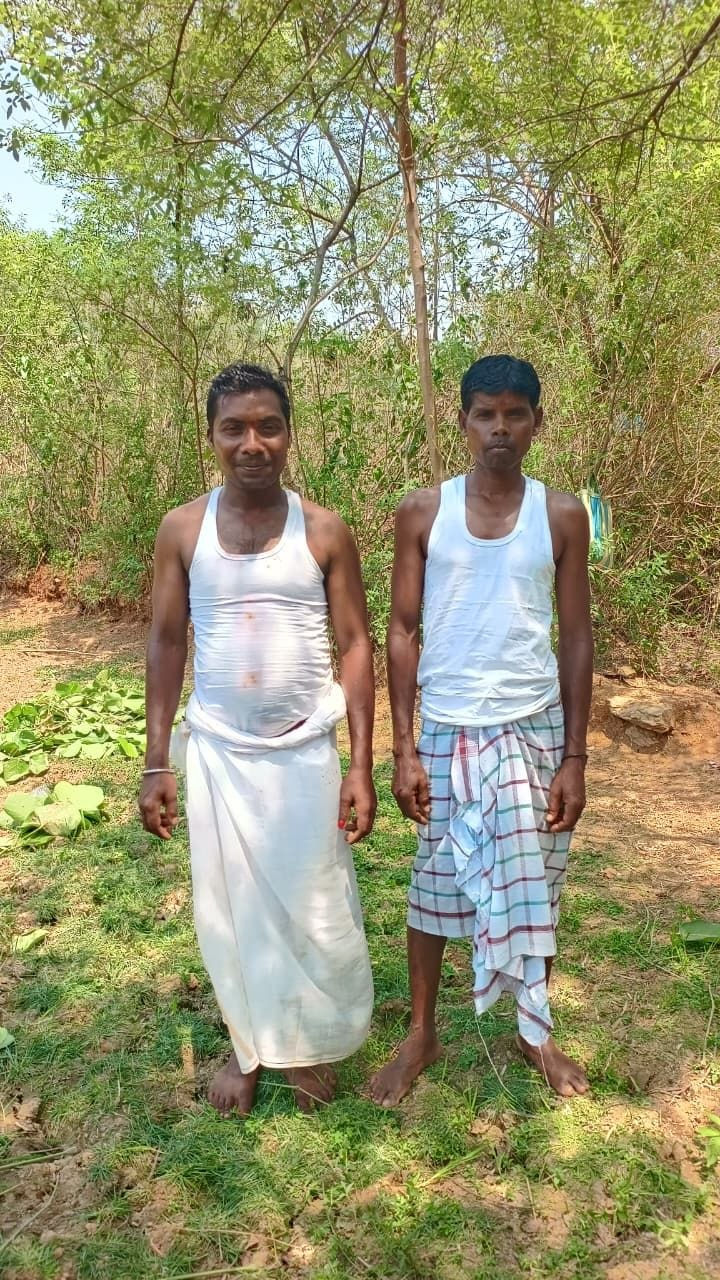
The ritual is led by the Dehri, the hereditary priest whose role passes from father to son. Goddess Paudi will accept the sacrifice only from his hands. Each household contributes roughly ₹200 to a shared fund for the sheep. The men who take part must wear only a vest and dhoti. It is a way of leaving the everyday self behind before stepping onto sacred ground. Women are excluded entirely. They do not make the trek to the summit and are not told what happens there.
At the top, offerings are laid before Goddess Paudi: kumkum, mahua flowers, mangoes, and sweetmeats. The Dehri performs the sacrifice. The year's prayers and worries are channelled through a single act. Afterward, the men cook the sacrificed sheep in the forest over an open fire before heading back to the village.
Women may not eat this meat. The belief is firm: if a woman were to eat the sacred offering, something bad would befall the village. Portions are sent to men who could not make the trek, but the restriction on women holds without exception. They contribute to the offering fund and wash the feet of the returning men, and yet the sacred space of the Bonga has always been closed to them.

When I came back from the mountain with photographs, the women of Edelbera gathered around and asked to see them. They had lived beside this ritual their whole lives and had never once seen it.
After the feet are washed, the men sit together with the Dehri at the centre. Cups of Rasi, a fermented rice drink traditional to the Mahali, are passed around. And they talk. They name what went wrong in the year. They speak about what is weighing on them. The festival does not end with the sacrifice. It ends with honesty.
But pause on the goddess at the summit: Paudi. She is not an original Mahali deity. Her presence there, worshipped in the same ritual as Marang Buru, is itself a sign of something. Two traditions sharing one sacred space. Easy to miss, but worth noticing. And it points directly to the second story.
A Goddess from Elsewhere: Maa Kera
If the Marang Buru Bonga shows what the Mahali have always carried, the Maa Kera Puja shows what they chose to take in. It is the story of a goddess who was not theirs, and how she became one of the most important figures in their lives.
The Marang Buru Bonga belongs to the Mahali the way the forest belongs to West Singhbhum: deeply, and without question. The Maa Kera Puja is a different story.
To understand it, you have to go back further. The Mahali are an offshoot of the Santal and Munda tribal families, and their original faith was pure animism, a deep reverence for nature. Their ancestral deities were Surjahi Devi, the solar goddess, and Bar Pahari, the mountain spirit. They celebrated forest-based festivals like Karam and Badina. The divine, for them, lived in the sun, the forest, and the mountain. Not in temple idols.
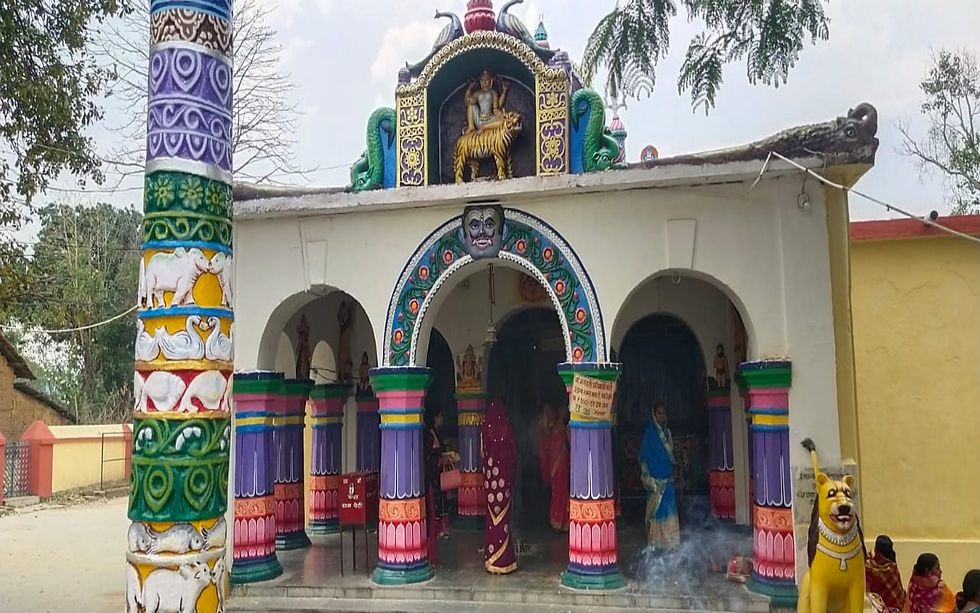
According to Tapeshwar Mahali, roughly 350 to 400 years ago, a saint is said to have walked from Kamrup Kamakhya in Assam into what is now West Singhbhum, carrying an idol of Maa Bhagwati. After the saint died, the local ruler, Thakur Loknath Singhdev of the Kera estate, built a temple for the idol in Kera village near Chakradharpur. This was the birth of the Maa Kera Temple. The goddess inside, a form of Goddess Durga or Bhagwati, had no roots in Mahali tradition. She came from the Hindu-Shakti tradition and belonged, at first, to the kingdom and the farming communities around it.
The Mahali had come to West Singhbhum in search of forests. Bamboo was plentiful here. They settled around Chakradharpur and the surrounding villages and lived side by side with the communities of the Kera kingdom. Over generations of shared harvest seasons, shared festivals, and shared land, Maa Kera slowly entered their homes.
Through the quiet, everyday work of living beside people who believed in her, the goddess who once belonged to a kingdom became the protector of the Mahali household.
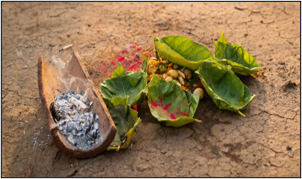
Today, every year during the Chaitra Parv, Mahali families across West Singhbhum perform the Maa Kera Puja before eating the first mahua flowers and mangoes of the season. The ritual follows a set order: a bath at dawn, offerings arranged in sal leaf bowls, the sacrifice of a rooster, the sharing of meat, and then khichdi. Lentils and rice, cooked and eaten by the household alone, with no guests and no gathering.
"If the family remains free from any danger in the year ahead, we will continue our worship and remain committed to this practice of giving thanks every Chaitra." — Revathi Mahali
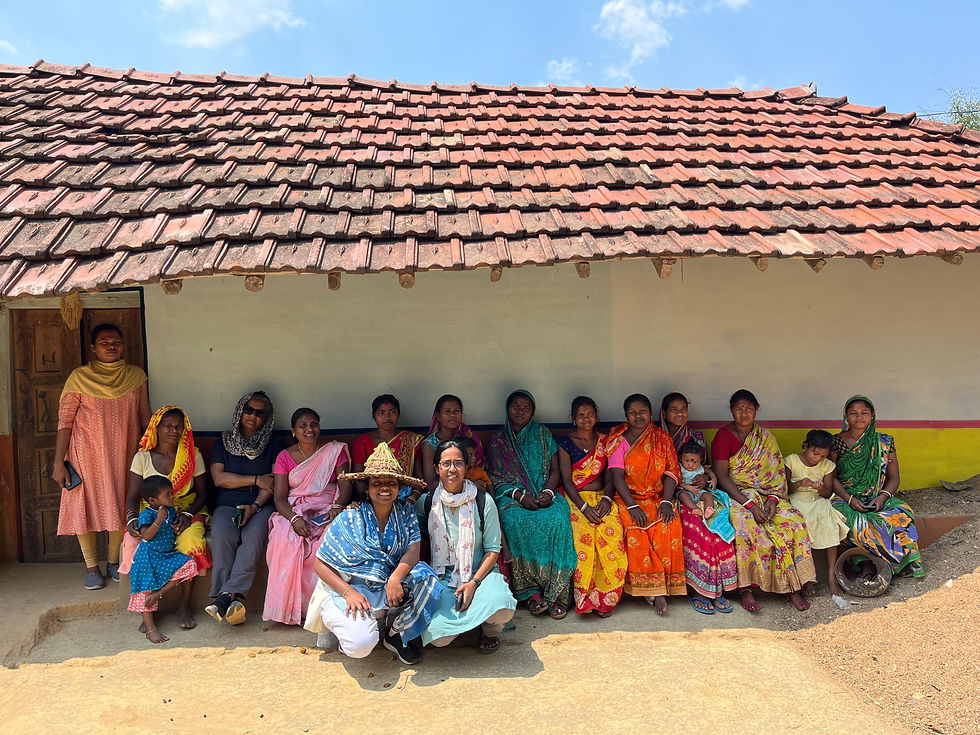
When I spoke to the women of Edelbera about their faith, some of them said simply, "We are Hindu." They said it without hesitation. But it would be a simplification to leave it there. The Mahali, like many Adivasi communities across Jharkhand, have a complex relationship with religious identity. Many continue to follow the Sarna faith, the original nature-based belief system of the region's tribal communities. Others move between worlds, carrying both. The categories of Hindu and Sarna do not always sit in opposition here and not every person in the village would use the same label for themselves.
The women explained that their families have been worshipping Maa Kera for generations. "Our mothers did it, our grandmothers did it, and we do it too," one woman told me. Another said, "Maa Kera is our goddess. We have always gone to her."
Nearly four hundred years of living with this worship has made it a natural part of village life. Today, the Puja is not seen as something outside or borrowed. It has become part of who the people of Edelbera are. But identity is not only about what a community worships. It is also about who belongs. And that is where the third ritual begins.
The Feast for Those Who Marry Out
The Mahali speak of a third ritual as well. It is not about the mountain or the goddess. It begins when someone chooses to marry outside the tribe.
If a Mahali decides to marry outside the community, they must feed the entire village. The meal is a full feast of Khasi Bhat, slow-cooked goat meat curry served with rice, prepared for every household in the neighbourhood. Once the village has eaten together, the newlyweds are formally welcomed back into the Samaj, the body that governs Mahali social life.
"Hum kissi ko bhi samaj se nikala nahi dete hai. Agar koi humare samaj se bahar shadi karega toh usko pure gaon ko mutton bhat khilana padhta hai." — Bishweshwar Mahali, 25, Edelbera
There was a time when the fear of marrying outside the community was about more than social rules. It was economic. For generations, the Mahali's main work was weaving bamboo into baskets, mats, and storage vessels. A woman who came from outside the tribe would not know the craft. She would not know how to cut, soak, or weave the cane. If that knowledge was not passed on, the family's ability to earn would slowly weaken. So would their ability to contribute to the shared funds that kept rituals like the Bonga alive. The fear was not about purity. It was about survival.
Today, that fear has loosened because the world around it has changed. Cheap plastic goods have flooded local markets, and what a skilled artisan once made now earns as little as ₹200 to ₹250 for a full day's work. Younger Mahali are moving toward daily wage labour and seasonal work in other places. The craft is slowly disappearing. The reasons have less to do with who someone marries and more to do with how hard it has become to earn a living from bamboo. The old restriction has softened along with it.
"Humare samaj mein koi aise nahi nikalta hai na didi. Itni aasan se apna leta hai, isiliye sabhi bahar shadi kar ke laraha hai." — Revathy Mahali, Anganwadi Worker, Edelbera
What do the Rituals Say?
Three rituals. One community. Each one tells a different part of the same story.
The Marang Buru Bonga is the oldest. It is tied to the mountain, to ancestral beliefs, and to a yearly act of collective prayer and honesty. And yet even here, Goddess Paudi stands at the summit alongside Marang Buru. Two traditions sharing one sacred space, quietly, for generations.

The Maa Kera Puja came from outside. It arrived through proximity, through centuries of shared living with communities who believed in her. And over time, what was once unfamiliar became inseparable from daily life. Today, the worship of Maa Kera is spoken of as their own tradition, not something borrowed.
The feast for those who marry outside shows a community negotiating its own boundaries. For a long time, those boundaries were held firm by economic necessity. As that necessity fades, the boundary softens too. The Samaj still gathers, still decides, still welcomes people back over a shared meal. But what it is protecting has quietly changed.
Yet much remains the same. Every year, people still walk to the mountain. Offerings are still made. Maa Kera is still worshipped. The Samaj still gathers, shares food and drink, and settles what needs to be settled.
The rituals continue, but they now exist in a world very different from the one in which they first took shape. The Mahali are carrying old traditions into new times. Some things stay the same. Others take on new meaning. What to keep, what to adapt, and what to pass on are decisions still being made, quietly, within the community itself.
Note: There are multiple versions of the story of Maa Kera, each shaped by the community or region from which it is told. This article presents one of those versions, as shared by members of the Mahali community in Edelbera village, West Singhbhum. About the Author: Taha Kausar is a policy researcher and development practitioner based in Vijayapura, Karnataka. A former Gandhi Fellow (Batch 17) with the Piramal Foundation, she is interested in public policy, grassroots governance, and documenting community experiences. She holds an MA in Public Policy and a BA in Journalism and Mass Communication.

This exploration of Mahali rituals beautifully illustrates how cultural identity is a living, breathing entity, constantly shaped by both ancient traditions and adopted practices. The integration of Maa Kera, a goddess from elsewhere, alongside the ancient Marang Buru Bonga, speaks volumes about resilience and adaptation. It highlights the dynamic interplay of community and outside influence, not unlike the complex social dynamics one might encounter in sz games.
I really appreciated the way the author organised the information. I found the way the different facets of the topic are addressed interesting. I found this text particularly useful for a project I am working on. It is an article that stands out for the quality of the information presented.
I read this text with great interest and found several useful insights. The content is well balanced between theory and practical applications. I sent the link to a few friends interested in this subject. It is a well-made text that answers many questions on the topic.
The text is very well written and the information is presented logically. The content is well balanced between theory and practical applications. I pointed this text out to a colleague who was looking for similar information. It does not often happen to find such a balanced text on this topic.
I appreciated the clarity with which the various concepts are explained. The author demonstrates a good knowledge of the subject. I saved the link to share it with those who might find it useful. It is not common to find articles that manage to cover this topic so well.